Hey there, fellow homeschool parents!
If you’ve been hanging around the educational community lately, you’ve probably noticed that the landscape is shifting. Families today have more freedom and choices than ever before. While traditional homeschooling remains a beautiful, time-tested pillar of alternative education, a newer player has entered the chat: microschools.
Both options offer incredible departures from the one-size-fits-all public school model, but they look and feel very different in practice. If you’re re-evaluating your routine for the upcoming school year, let’s break down the differences to help you find your family’s sweet spot.
What Is Homeschooling? (The Ultimate Flexibility)
At its core, homeschooling places you—the parent—in the driver’s seat. You are the principal, the guidance counselor, and often the primary teacher. You choose the curriculum, set the daily rhythm, and decide how and when your child is assessed.
Many homeschool families thrive on the ultimate freedom to:
- Learn at their own pace: Spend three weeks on fractions or blast through a year of history in a semester.
- Embrace roadschooling: Take advantage of off-season travel and turn family trips into living history lessons.
- Follow rabbit trails: Lean heavily into a child’s current obsession, whether it’s marine biology or ancient Egypt.
- Tailor the worldview: Easily incorporate faith-based, secular, or highly specialized curricula.
The Pro/Con Breakdown
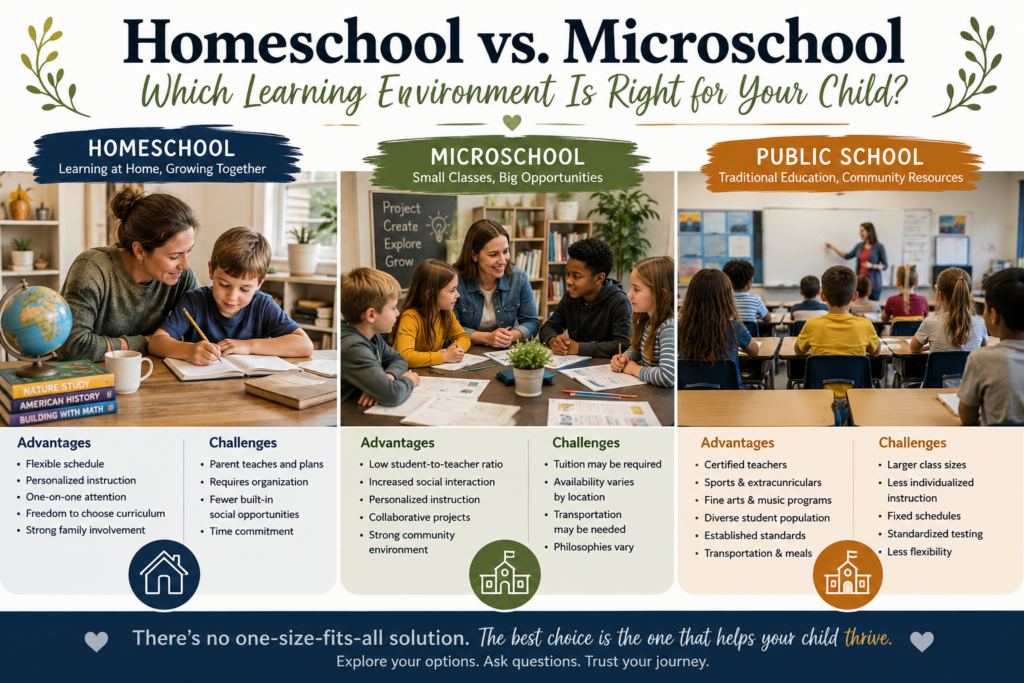
| The Joys of Homeschooling | The Reality Checks |
| Total customization of schedule and curriculum | Heavy lifting: Parents carry the bulk of planning and teaching. |
| Deep family bonds and shared learning experiences | Time commitment: Often requires one parent to reduce work hours. |
| One-on-one attention that maximizes efficiency | Intentional socialization: You must actively seek out co-ops, sports, and clubs. |
What Is a Microschool? (The Modern One-Room Schoolhouse)
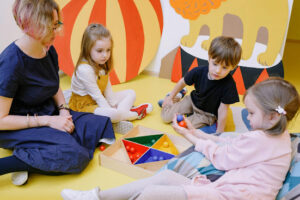
Think of a microschool as a boutique learning community. It beautifully blends the personalized, tight-knit feel of homeschooling with the structure of a classroom setting. Usually comprised of just 5 to 20 students, microschools often meet a few days a week and are frequently led by certified teachers or expert educators.
In a microschool, your child will often experience:
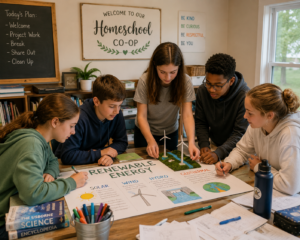
- Project-based learning: Deep, hands-on group projects rather than endless worksheets.
- Multi-age classrooms: Just like the old-school one-room schoolhouses, older and younger kids learn alongside each other.
- Community partnerships: Frequent field trips and local expert mentors.
The Pro/Con Breakdown
| The Joys of Microschools | The Reality Checks |
| Built-in community and daily social interaction | Financial cost: Tuition is typically required. |
| Expert-led instruction takes the pressure off parents | Location lottery: Availability varies wildly depending on where you live. |
| Collaborative environment for group projects | Less control: You must align with the school’s specific philosophy and schedule. |
How Do They Stack Up Against Traditional Public Schools?
To understand why so many families are pivoting to homeschooling or microschools, it helps to look at the traditional public school framework. Public schools offer fantastic resources—like robust sports programs, diverse student populations, and certified specialists—all funded by taxpayers.
However, many families hit a wall with public school due to rigid schedules, large class sizes, and the high-stress environment of standardized testing. Both homeschooling and microschools step in to reclaim that lost flexibility and center the education back on the individual child.
Which Path Is Right for Your Family?
There is no “right” answer here—only what is right for your family, for this specific season.
Pro Tip: You don’t actually have to choose just one! The modern educational world is beautifully fluid. Many hybrid families choose to homeschool part-time while enrolling their kids in a microschool or a local co-op a couple of days a week.
When making your decision, ask yourself:
- How much time do I realistically have to dedicate to lesson planning and teaching right now?
- Does my child thrive more in a solitary environment, or do they crave a consistent peer group to collaborate with?
- What does our family budget look like for curriculum vs. tuition?
Education isn’t about finding a “perfect” system; it’s about curating an environment where your child can grow academically, socially, and emotionally. Take some time this weekend to research local groups, chat with your kids, and remember: you have the freedom to pivot whenever you need to!